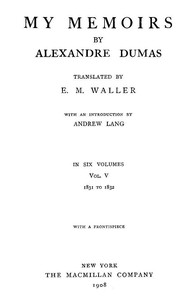
My Memoirs, Vol. V, 1831 to 1832 by Alexandre Dumas

(5 User reviews)   806
Dumas, Alexandre, 1802-1870 Dumas, Alexandre, 1802-1870
English
Ever wonder what it's like to be famous, broke, and fighting for your life all at once? In this wild fifth volume of his memoirs, Alexandre Dumas—yes, the guy who wrote The Three Musketeers—isn't just spinning tales of adventure, he's living one. We catch up with him in 1831, a literary star in Paris, but the revolution he cheered for is turning sour. He's juggling fame, massive debts, and a cholera epidemic that's emptying the streets. The real mystery isn't in a plot—it's how Dumas manages to write legendary stories while his own life is this chaotic. It's less a polished autobiography and more a backstage pass to history, told by a man who was right in the middle of it, trying to make sense of the mess.
Share

Read "My Memoirs, Vol. V, 1831 to 1832 by Alexandre Dumas" Online

This book is available in the public domain. Start reading the digital edition below.

START READING FULL BOOK
Instant Access    Mobile Friendly

Book Preview

A short preview of the book’s content is shown below to give you an idea of its style and themes.

captain, and Saint-Évre second captain, of the fourth battery. The first and second battery formed a squadron; the third and fourth a second squadron. The first squadron was commanded by Thierry, who has since become a municipal councillor, and is now Medical Superintendent of Prisons, I believe. The second squadron was commanded by a man named Barré, whom I lost sight of after 1830, and I have forgotten what has become of him. Finally, the whole were commanded by Comte Pernetti, whom the king had appointed our colonel. I had, therefore, reached the crown of my wishes: I was an artilleryman! There only remained for me to exchange my uniform as a mounted national guardsman for an artillery uniform, and to make myself known to my commanding officers. My exchange of uniform was not a long job. My jacket and trousers were of the same style and colour as those of the artillery, so I only had to have a stripe of red cloth sewed on the trousers instead of the silver one; then, to exchange my epaulettes and my silver cross-belt at a military outfitter's for epaulettes and a red woollen foraging rope. The same with regard to my schako, where the silver braid and aigrette of cock's feathers had to be replaced by woollen braiding and a horse-hair busby. We did not need to trouble ourselves about carbines, for the Government lent us these; "_lent them_" is the exact truth, for twice they took them away from us! I lighted upon a very honest military outfitter, who gave me woollen braid, kept all my silver trimmings, and only asked me for twenty francs in return; though, it is true, I paid for my sword separately. The day after I had received my complete costume, at eight o'clock in the morning, I made my appearance at the Louvre to take my part in the manœuvres. We had there twenty-four pieces of eight, and twenty thousand rounds for firing. The Governor of the Louvre was named Carrel, but he had nothing in common with Armand Carrel, and I do not think he was any relation to him. The artillery was generally Republican in tone; the second and third battery, in particular, affected these views. The first and fourth were more reactionary; there would be quite fifty men among them who, in the moment of danger, would unite with the others. As my opinions coincided with those of Bastide, Guinard, Cavaignac and Thomas, it is with them that I shall principally deal; as for Captains Arnoux and Olivier, I knew them but little then and have never had occasion to see them again. May I, therefore, be allowed to say a few words of these men, whose names, since 1830, are to be found in every conspiracy that arose? Their names have become historic; it is, therefore, fitting that the men who bore them, or who, perhaps, bear them still, should be made known in their true light. Let us begin with Bastide, as he played the most considerable part, having been Minister of Foreign Affairs in 1848. Bastide was already at this time a man of thirty, with an expression of countenance that was both gentle and yet firm; his face was long and pale, and his black hair was close cut; he had a thick black moustache, and blue eyes, with an expression of deep and habitual melancholy. He was tall and thin, extremely deft-handed, although he looked rather awkward on account of the unusual length of his neck; in conclusion, he was an adept in the use of...

This is a limited preview. Download the book to read the full content.

Forget everything you think you know about stuffy old memoirs. This isn't a dry history lesson. It's Dumas, live and uncensored. The Story picks up with Dumas as a successful playwright, but success in 1830s Paris is a shaky thing. The July Revolution he supported has led to a disappointing new king. The city is gripped by a terrifying cholera outbreak. And Dumas, despite his fame, is constantly dodging creditors. The book follows him through this turbulent year as he writes, socializes, argues politics, and simply tries to survive in a city that feels like it's coming apart at the seams.

Why You Should Read It

This is where you see the man behind the books. Dumas doesn't just report events; he makes you feel the panic of the epidemic, the frustration of political betrayal, and the dark humor of being penniless in high society. His energy is incredible. Even when describing a city in crisis, his voice is so alive and immediate. You get his fiery opinions, his gossip about other writers, and his very real fears. It makes the grand historical events feel personal and human.

Final Verdict

Perfect for fans of Dumas's novels who want to meet the real d'Artagnan, or for anyone who loves peeking behind the curtain of a dramatic historical moment. If you enjoy biographies with personality and history that feels like a story, not a textbook, this volume is a fascinating and surprisingly fast-paced read. Just be prepared—the author's life is every bit as dramatic as his fiction.


📢 Open Access

This historical work is free of copyright protections. Access is open to everyone around the world.

Emily Perez
5 months ago

Believe the hype, the insights offered are both practical and thought-provoking. This made complex ideas feel approachable.

Carol Moore
3 months ago

At first I wasn’t convinced, but the plot twists are genuinely surprising without feeling cheap or forced. I’ll be referencing this aggain soon.

Matthew Rodriguez
1 month ago

Out of sheer curiosity, the storytelling feels authentic and emotionally grounded. An impressive piece of work.

Karen Wright
4 weeks ago

I rarely write reviews but the clarity of the writing makes this accessible to a wide audience. Simply brilliant.

Liam Campbell
2 months ago

After looking for this everywhere, the interplay between the protagonists drives the story forward beautifully. This has earned a permanent place in my collection.

5
5 out of 5 (5 User reviews )

Add a Review

Your Rating *
There are no comments for this eBook.
You must log in to post a comment.
Log in

Related eBooks