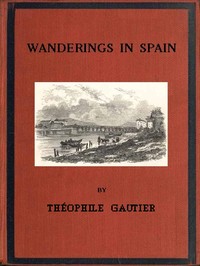
Wanderings in Spain by Théophile Gautier

(4 User reviews)   914
Gautier, Théophile, 1811-1872 Gautier, Théophile, 1811-1872
English
Hey, have you ever wanted to travel back in time? Not just to see old buildings, but to feel what a place was really like before tourists and guidebooks? That's the magic of 'Wanderings in Spain.' Forget the dry history—this is the raw, unfiltered journal of a French artist, Théophile Gautier, who trekked across Spain in 1840. He wasn't a scholar; he was a guy with a keen eye for beauty and a knack for getting into strange situations. The real question isn't where he goes, but what he finds when he gets there. It's less about destinations and more about the wild characters, sudden adventures, and stunning sights that jump out at him around every dusty corner. Think of it as the world's most eloquent and accidentally funny travel vlog, written 180 years ago.
Share

Read "Wanderings in Spain by Théophile Gautier" Online

This book is available in the public domain. Start reading the digital edition below.

START READING FULL BOOK
Instant Access    Mobile Friendly

Book Preview

A short preview of the book’s content is shown below to give you an idea of its style and themes.

going down into the cellar to fetch your wine is entirely avoided. Château-Regnault is a small town built upon a number of serpentine and rapid declivities, bordered by ill-pitched and tottering houses, which appear to lean against one another to keep themselves upright. A large round tower, situated upon the talus of some old fortifications, enveloped here and there in green patches of ivy, redeems, to a certain extent, the appearance of the town. From Château-Regnault to Tours there is nothing remarkable. Earth in the middle, and trees on each side, forming those long yellow bands, which lose themselves in the distance, and which, in the language of the wagoners, are termed _rubans de queue_, are all that is to be seen: then, on a sudden, the road dives down a couple of pretty steep hills, and in a few minutes you perceive the town of Tours, rendered famous by its prunes, Rabelais, and de Balzac. The Bridge of Tours is very celebrated, and possesses in itself nothing exceedingly remarkable; but the appearance of the town is lovely. On my arrival, the sky, with a few flakes of snow floating negligently over its surface, was tinged with the sweetest blue; a white line, similar to that traced by a diamond upon glass, cut the limpid surface of the Loire, and was formed by a tiny cascade proceeding from one of the sand-banks so frequent in the bed of this river. In the clear air, Saint Gatien reared its brown profile and Gothic spires, ornamented with balls and roundings similar to those of the steeples of the Kremlin, giving to the city a most romantically Muscovite air; a few other towers and spires, belonging to churches the names of which I do not know, completed the picture; while numerous vessels, with their white sails, floated, like so many sleeping swans, upon the azure bosom of the stream. I should have liked to have paid a visit to the house of Tristan l'Ermite, the terrible gossip of Louis XI., which is still in a marvellous state of preservation, with its horribly significant ornaments, composed of coils of rope, entwined with other instruments of torture; but I had not time; I was obliged to content myself with the _Grande Rue_, which must be the pride of the inhabitants of Tours, and which aspires to the rank of another _Rue de Rivoli_. Châtellerault, which enjoys a high reputation for the article of cutlery, possesses nothing particular except a bridge, ornamented at each extremity with old towers, which present a most charmingly feudal and romantic appearance. As for its manufactory of arms, it is a large white mass, with a multitude of windows. Of Poitiers, having passed through it in a beating rain, and a night as dark as pitch, I can say nothing, except that it is paved in the most execrable manner possible. At break of day, the coach was traversing a country wooded with trees of an apple green planted in a soil of the brightest red, and producing a very singular effect. The houses were covered with tiles ridged after the Italian fashion; these tiles, too, were staring red, a colour which appears very strange to eyes accustomed to the brown and sooty roofs of the houses of Paris. From a piece of eccentricity, of which I forget the motive, the builders of those parts commence at the roofs of the houses; the walls and foundations follow. They place the framework upon four strong beams, and the tilers perform their portion of the work before the masons. It is about this...

This is a limited preview. Download the book to read the full content.

Published in 1843, this isn't a novel with a plot. It's the real-life travel diary of French writer and critic Théophile Gautier. In the 1840s, he embarked on a long journey through Spain, from the Basque Country down to Andalusia. The 'story' is simply his path and his observations. He describes everything: chaotic inns, breathtaking cathedrals, bullfights that thrill and horrify him, and quiet moments watching the light change on ancient walls. He meets smugglers, dancers, monks, and everyday people, painting vivid pictures of a country on the cusp of modern change.

Why You Should Read It

Gautier writes with the soul of a painter. His descriptions are so sharp and colorful, you can almost smell the orange blossoms and hear the click of castanets. What I love is his honesty. He's sometimes enchanted, sometimes frustrated, and always curious. He doesn't romanticize the rough travel conditions, but he's utterly captivated by the art, the landscapes, and the spirit of the place. Reading this feels like having a brilliant, slightly dramatic friend sending you detailed letters from an epic trip.

Final Verdict

Perfect for armchair travelers, history lovers who want a personal view, and anyone who appreciates beautiful, observant writing. If you enjoy travelogues by writers like Bill Bryson or Paul Theroux, you'll find their 19th-century French cousin here. It's a captivating portal to a lost Spain, seen through the wonderfully perceptive eyes of a true artist.


⚖️ Legacy Content

Legal analysis indicates this work is in the public domain. Distribute this work to help spread literacy.

Mark White
3 weeks ago

As someone who reads a lot, the examples used throughout the text are practical and relevant. It is definitely a 5-star read from me.

Barbara Scott
5 months ago

I was pleasantly surprised because the storytelling feels authentic and emotionally grounded. A perfect companion for a quiet weekend.

Elijah Robinson
5 months ago

I was skeptical at first, but the tone remains consistent and professional throughout. Don't hesitate to download this.

Donald Allen
5 months ago

Reading this felt refreshing because the balance between theory and practice is exceptionally well done. It exceeded all my expectations.

4.5
4.5 out of 5 (4 User reviews )

Add a Review

Your Rating *
There are no comments for this eBook.
You must log in to post a comment.
Log in

Related eBooks