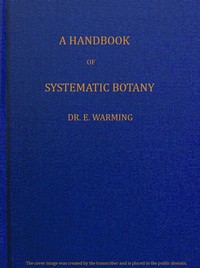
A handbook of systematic botany by Eugenius Warming

(5 User reviews)   712
Warming, Eugenius, 1841-1924 Warming, Eugenius, 1841-1924
English
Hey, I just finished something completely different – a book about plants from the 1800s. It's not a story, but it feels like an adventure. Think of it as a field guide written by a detective who's trying to solve the biggest mystery of all: how to make sense of the entire plant world. Eugenius Warming didn't just list flowers and trees; he built the filing system botanists still use today. It's like finding the original blueprint for how we understand nature. If you've ever looked at a weird plant and wondered 'What *is* that and where does it fit?', this is the book that started giving us the answers.
Share

Read "A handbook of systematic botany by Eugenius Warming" Online

This book is available in the public domain. Start reading the digital edition below.

START READING FULL BOOK
Instant Access    Mobile Friendly

Book Preview

A short preview of the book’s content is shown below to give you an idea of its style and themes.

Classification adopted in the Danish Edition is given in the Appendix. In the Angiosperms I have retained the sequence of orders in the Danish original, and have not rearranged them according to the systems more familiar to English students. In any rearrangement much of the significance of Dr. Warming’s valuable and original observations would have been lost, and also from a teacher’s point of view I have found this system of great value. Although at present it may not be completely satisfactory, yet as an attempt to explain the mutual relationships, development and retrogression of many of the orders, it may be considered to have a distinct advantage over the more artificial systems founded upon Jussieu’s Divisions of Polypetalæ, Gamopetalæ, and Apetalæ. With reference to the principles of the systematic arrangement adopted, I may here insert the following brief communication from the author (dated March, 1890), which he has requested me to quote from the preface of Dr. Knoblauch’s edition:--“Each form which, on comparative morphological considerations, is clearly less simple, or can be shown to have arisen by reduction or through abortion of another type having the same fundamental structure, or in which a further differentiation and division of labour is found, will be regarded as younger, and as far as possible, and so far as other considerations will admit, will be reviewed later than the ‘simpler,’ more complete, or richer forms. For instance, to serve as an illustration: EPIGYNY and PERIGYNY are less simple than HYPOGNY; the Epigynous _Sympetalæ_, _Choripetalæ_, _Monocotyledones_ are, therefore, treated last, the _Hydrocharitaceæ_ are considered last under the _Helobieæ_, etc. ZYGOMORPHY is younger than ACTINOMORPHY; the _Scitamineæ_ and _Gynandræ_ therefore follow after the _Liliifloræ_, the _Scrophulariaceæ_ after the _Solanaceæ_, _Linaria_ after _Verbascum_, etc. FORMS WITH UNITED LEAVES indicate younger types than those with free leaves; hence the _Sympetalæ_ come after the _Choripetalæ_, the _Sileneæ_ after the _Alsineæ_, the _Malcaceæ_ after the _Sterculiaceæ_ and _Tiliaceæ_, etc. “ACYCLIC (spiral-leaved) flowers are older than cyclic (verticillate-leaved) with a definite number, comparing, of course, only those with the same fundamental structure. The _Veronica_-type must be considered as younger, for example, than _Digitalis_ and _Antirrhinum_, these again as younger than _Scrophularia_; _Verbascum_, on the contrary, is the least reduced, and therefore considered as the oldest form. Similarly the one-seeded, nut-fruited _Ranunculaceæ_ are considered as a later type (with evident abortion) than the many-seeded, folicular forms of the Order; the _Paronychieæ_ and _Chenopodiaceæ_ as reduced forms of the _Alsineæ_ type; and the occurrence of few seeds in an ovary as generally arising through reduction of the many-seeded forms. The _Cyperaceæ_ are regarded as a form derived from the _Juncaceæ_ through reduction, and associated with this, as is so often the case, there is a complication of the inflorescence; the _Dipsacaceæ_ are again regarded as a form proceeding from the _Valerianaceæ_ by a similar reduction, and these in their turn as an offshoot from the _Caprifoliaceæ_, etc. Of course these principles of systematic arrangement could only be applied very generally; for teaching purposes they have often required modification.” In preparing the translation considerable difficulty has been experienced in finding a satisfactory rendering of several terms which have no exact equivalent in English. I may here especially mention the term Vorblatt (Forblad) which I have translated by the term bracteole, when it clearly applied to the first leaf (or leaves) on a pedicel; but in discussing questions of general morphology a term was much needed to include both vegetative and floral shoots, and for this I have employed the term “Fore-leaf.” Also, the term “Floral-leaf” has been adopted as an equivalent of “Hochblatt,”...

This is a limited preview. Download the book to read the full content.

Let's be clear from the start: this isn't a novel. A Handbook of Systematic Botany is exactly what it sounds like – a manual. Published in the late 19th century, it's Eugenius Warming's attempt to bring order to the chaotic, beautiful world of plants. He walks readers through the logic of plant classification, explaining how scientists group everything from massive trees to tiny mosses based on their shared characteristics. It's the foundational text for the system we use to name and organize plant life.

Why You Should Read It

Reading this is like sitting with a brilliant, patient teacher from another time. You get to see scientific thinking in its raw, formative stages. Warming's passion is palpable; he isn't just cataloging, he's revealing a hidden structure in nature. It makes you look at every garden, forest, or even weed in a sidewalk crack with new eyes. You start to see the relationships and the grand family tree connecting all green things.

Final Verdict

This is a niche read, but a fascinating one. It's perfect for history of science enthusiasts, serious gardeners or botany students curious about their field's roots, and anyone who enjoys primary sources that show how big ideas are built. It's not a casual bedtime read, but for the right person, it's a quiet masterpiece of organization and observation.


ℹ️ Public Domain Notice

You are viewing a work that belongs to the global public domain. Enjoy reading and sharing without restrictions.

Michelle Green
1 month ago

This is one of those books where the storytelling feels authentic and emotionally grounded. Truly inspiring.

Ethan Wright
5 months ago

Honestly, it creates a vivid world that you simply do not want to leave. I finished this feeling genuinely satisfide.

Thomas Lee
2 months ago

I almost skipped this one, yet it manages to explain difficult concepts in plain English. This deserves far more attention.

Patricia Hill
2 months ago

After finishing this boo,k it serves as a poignant reminder of the human condition. Don't hesitate to download this.

William Walker
4 months ago

I approached this with curiosity because the author avoids unnecessary jargon, which is refreshing. This deserves far more attention.

5
5 out of 5 (5 User reviews )

Add a Review

Your Rating *
There are no comments for this eBook.
You must log in to post a comment.
Log in

Related eBooks