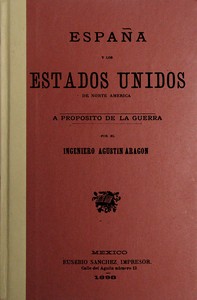
España y los Estados Unidos de Norte América : a propósito de la guerra by Aragón

(5 User reviews)   1116
Aragón, Agustín, 1870-1954 Aragón, Agustín, 1870-1954
Spanish
Hey, I just read this fascinating old book that feels eerily relevant today. It's a 1900 Spanish perspective on the Spanish-American War, written just two years after it ended. The author, Agustín Aragón, wasn't just analyzing battles; he was trying to figure out what the sudden rise of the United States meant for the world, especially for former empires like Spain. It's less about who won and more about asking, 'What just happened, and what does it mean for the future?' The passion and worry in his writing is palpable. If you like history that reads like a thoughtful, urgent letter from the past, this is a hidden gem.
Share

Read "España y los Estados Unidos de Norte América : a propósito de la guerra by Aragón" Online

This book is available in the public domain. Start reading the digital edition below.

START READING FULL BOOK
Instant Access    Mobile Friendly

Book Preview

A short preview of the book’s content is shown below to give you an idea of its style and themes.

Examinemos las causas de la guerra desde el punto de vista moral. El derecho de gentes, no es en rigor una ley: es simplemente la _costumbre_ de las naciones, ó mejor dicho, un conjunto de usos internacionales que, de la misma manera que otros usos, ha nacido ó de un sentimiento de justicia ó de la comunidad de intereses ó de opiniones y preocupaciones arraigadas. ¿Es racional exigir que cuando todo cambia y varía, se transforma y evoluciona, no varíe la ley de las naciones? No, contestamos enérgicamente. El derecho internacional se ha transformado y deberá transformarse, ha evolucionado en el presente siglo y evolucionará en los venideros, y asuntos que antes no motivaban una intervención de las naciones, la motivan hoy por asentimiento unánime de las mismas. ¿Puede haber un motivo de intervención más simpático y más urgente, y más irresistible que el de ayudar á un pueblo amoroso de su libertad, que toma las armas contra un tirano que oprime y explota, contra un opresor extranjero? No, respondemos espontáneamente y casi sin darnos cuenta del raciocinio que nos conduce á ese enérgico adverbio de negación, porque el sacrificio de los fuertes en favor de los débiles es un precepto de moral para todo aquel que quiera vivir á la altura de nuestra época. Supongamos que en el caso de Cuba el pueblo de la isla careciese de todo espíritu de libertad durante su período colonial, y que pudiese considerarse al español como un opresor extranjero; nada más noble ni más elevado, ni más digno de espíritus superiores, que la protección del anglo-americano al cubano, para que éste conquiste las libertades á que aspira. Y sin embargo de lo anterior, ni en Europa ni en América se ha creido en la moralidad de los anglo-americanos. ¿Por qué cuando los franceses vinieron á Nueva Inglaterra á luchar contra los ingleses en favor de los colonos, no surgió el mismo sentimiento de desconfianza en la buena fe de los hijos de la patria de Molière y Richelieu? ¿Por qué hoy duda el mundo entero de los elevadísimos sentimientos humanitarios de los compatriotas de Grant, Austin y McKinley? Porque la idea de que el mundo está regido por leyes, de que no está sometido á incesantes variaciones, de que presentará mañana la misma serie de fenómenos que hoy y que ayer, es una idea que en cierto grado ha dominado á todos los cerebros humanos. Porque el francés ha sido y será siempre colectivamente desinteresado hasta el sacrificio, y el americano egoista y calculador hasta la avaricia. Porque el gran tipo del Quijote pintado por el _sublime_ Cervantes es latino y ante todo español, porque los quijotes no se conocen entre los sajones, y aun cuando el _tio Samuel_--personificación caricaturesca de nuestros vecinos del Norte--físicamente tenga parecido con el héroe de Cervantes, no podemos ver en él sino á un negociante disfrazado de Don Quijote. Porque, en fin, los antecedentes de los anglo-americanos y toda su historia nos inducen á dudar de su buena fe. Si el pueblo español se levanta en armas para socorrer á un oprimido, nadie duda de su caballerosidad y buena fe, porque es pueblo que ama lo grande y lo noble, lo bueno y lo bello. Veamos si hay algunas pruebas escritas, algunos hechos que justifiquen esa desconfianza con que han visto á los anglo-americanos todos los pueblos del planeta. Que la guerra ha sido causada por especuladores, quienes adquirieron millones de pesos en bonos de la Junta Cubana, los cuales distribuyeron entre altos funcionarios y entre los principales periódicos de sensación llamados «Yellow Journals,» se asegura...

This is a limited preview. Download the book to read the full content.

Published in 1900, this book isn't a standard military history. Agustín Aragón, a Mexican intellectual living in Spain, uses the recent war (1898) as a starting point for a bigger conversation. He looks at the clash between a fading European empire and a booming new world power, trying to understand the forces that led to Spain's defeat.

The Story

There's no traditional plot with characters. Instead, Aragón lays out his argument. He examines the political and cultural roots of the conflict, critiques Spain's internal weaknesses, and analyzes the explosive growth and ambition of the United States. He frames the war not as a simple loss, but as a symptom of a massive global shift in power. The 'story' is his attempt to make sense of that shift for his Spanish-speaking audience.

Why You Should Read It

What grabbed me was the raw, contemporary feel. This isn't a historian looking back with perfect clarity; it's a smart observer trying to process a recent, traumatic event. His warnings about American influence and his calls for Spanish and Latin American unity to face a new geopolitical reality are charged with emotion. You get a real sense of the intellectual shockwaves the war sent across the Atlantic.

Final Verdict

Perfect for readers who enjoy primary sources and seeing history unfold in real time. It's for anyone curious about how people in the past understood their own turning points. You won't get battlefield maps, but you'll get a compelling, opinionated take on the dawn of the 'American Century' from the other side of the fence. A short, dense, and thought-provoking window into a pivotal moment.


📢 Free to Use

This content is free to share and distribute. Feel free to use it for personal or commercial purposes.

Dorothy Baker
3 weeks ago

Having read this twice, the clarity of explanations makes revisiting sections worthwhile. Absolutely essential reading.

Betty Hall
4 months ago

A fantastic discovery, the writing style is poetic but not overly flowery. Well worth recommending.

Elizabeth Martinez
2 weeks ago

Honestly, the author demonstrates strong mastery of the topic. A solid resource I will return to often.

David Clark
6 months ago

It took me a while to start, but the writing style is poetic but not overly flowery. An excellent read overall.

Melissa Rodriguez
1 week ago

I had low expectations initially, however the structure supports both quick reading and deep study. Time very well spent.

5
5 out of 5 (5 User reviews )

Add a Review

Your Rating *
There are no comments for this eBook.
You must log in to post a comment.
Log in

Related eBooks