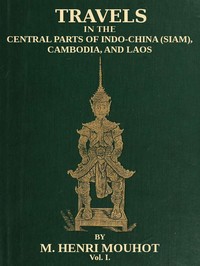
Travels in the Central Parts of Indo-China (Siam), Cambodia, and Laos (Vol.…

(5 User reviews)   913
Mouhot, Henri, 1826-1861 Mouhot, Henri, 1826-1861
English
Hey, have you ever wondered what it was like to be the first European to stumble upon the lost jungle temples of Angkor Wat? That's exactly what happened to French naturalist Henri Mouhot in the 1860s. This book is his incredible, firsthand account. It's not just a dry travel log—it's a survival story. Picture this: a lone explorer, armed with little more than curiosity, hacking his way through fever-ridden swamps and dense forests, facing down tigers and malaria, all to document a forgotten civilization. He didn't just find ruins; he brought a lost world back to life for readers in Europe. If you love real-life adventure with a huge dose of history, this is your next read.
Share

Read "Travels in the Central Parts of Indo-China (Siam), Cambodia, and Laos (Vol.…" Online

This book is available in the public domain. Start reading the digital edition below.

START READING FULL BOOK
Instant Access    Mobile Friendly

Book Preview

A short preview of the book’s content is shown below to give you an idea of its style and themes.

the circumstances under which this posthumous work sees the light. CHARLES MOUHOT. _Jersey, 1st December, 1862._ [Illustration: Drawn by M. Bocourt, from a Photograph. ONE OF THE SONS OF THE KING OF SIAM.] PREFACE. As will be seen, this work is compiled from the private letters of M. Mouhot to his family and friends, and from his journal. I had also the benefit of the paper destined by my brother for the Archæological Society of London, on the interesting ruins of Ongcor. Among the documents which, thanks to the active kindness of Sir R. Schomburgh, British Consul at Bangkok, of Dr. Campbell, R.N., and of M. D’Istria, French Consul, reached me as early as possible after my brother’s death, I found valuable sketches and drawings, together with various unfinished papers relative to his different scientific researches in the countries he had visited and in districts which had only recently been brought into notice by the advance of commerce, and by the military expeditions which had been sent to the extreme East. The family of M. Mouhot were divided in opinion as to the course to be adopted with regard to these varied materials. Should they be kept in a portfolio as a sacred but barren deposit, or should they be arranged in the best manner possible and laid before the public? After grave consideration they yielded to the representations of friends of the deceased, and to myself was confided the painful but interesting task of superintending the arrangement of the notes, sketches, and documents for publication. I accordingly set about it at once, under the first impressions of grief at the loss I had sustained, and guided only by fraternal love, for I lay no claim to the title of author. I have simply classified the masses of papers, the fruit of four years’ travel, and added a few explanatory notes. I have already stated the motives which induced me to dedicate this work to the Savans of England, more especially to those with whom my brother was connected through science or literature. Let me give a short sketch of the work for which we claim the indulgence of the public. I have first, preserving the chronological order, divided the journal into chapters, inserting in their appropriate places such portions of the private letters as served to throw light on the subject. This forms the body of the work. In an Appendix I have inserted the Chinese tales translated by the author during his residence in Siam--some unfinished papers which are only specimens of a zoological work which my brother intended to publish--the descriptions of the principal entomological and conchological specimens discovered by him, and which are now deposited in the Museums of London and Paris--the Cambodian vocabulary, a proof of his industry, of the variety of his knowledge, and of the care with which he collected everything which might be useful to his successors in the difficult path which he opened to them. Lastly, I have collected the letters of my brother to his family and other correspondents, together with some letters addressed to him, a few of which were never even received, while others only reached their destination after his death, or remained in the hands of friends who were charged to deliver them. This correspondence tends, I think, to display my brother’s character, the delicacy of his mind, and the goodness of his heart, qualities which have been recognised by so many, both during his life and after his death. The engravings from his drawings will impart interest to the descriptions of the ruins and vast buildings...

This is a limited preview. Download the book to read the full content.

In the mid-19th century, Henri Mouhot left everything behind for a journey into the unknown heart of Southeast Asia. His mission? To collect plant and animal specimens. What he found instead would change history.

The Story

The book follows Mouhot's grueling expedition through Siam (Thailand), Cambodia, and Laos. We travel with him by elephant and boat, sharing in the wonder of landscapes no Westerner had described before. The narrative's peak comes when he encounters the sprawling, vine-choked ruins of Angkor. His detailed sketches and awestruck descriptions of temples like Angkor Wat were the first to introduce this archaeological marvel to the Western world. The story is as much about his daily fight against disease, dangerous wildlife, and logistical nightmares as it is about his discoveries.

Why You Should Read It

You're right there with him. Mouhot's writing makes you feel the oppressive heat, hear the jungle sounds, and share his genuine shock at the scale of Angkor. It's a raw, unfiltered look at exploration before tourism. He doesn't cast himself as a hero; he's a fascinated observer, often humbled by the cultures and immense history he encounters. Reading it today, you get a double perspective: the thrill of discovery and a poignant look at a region on the brink of colonial change.

Final Verdict

Perfect for history buffs and armchair adventurers who want a true story that reads like an Indiana Jones prologue. It's also a great pick for travelers to Cambodia who want to understand the moment Angkor re-entered the global imagination. Be prepared for a book of its time—some attitudes will feel dated—but as a primary source of pure, daring exploration, it's completely gripping.


ℹ️ Community Domain

Legal analysis indicates this work is in the public domain. You can copy, modify, and distribute it freely.

Logan Mitchell
3 months ago

Based on the reviews, I decided to try it and the emotional weight of the story is balanced perfectly with moments of levity. I’d rate this higher if I could.

Brian Moore
4 months ago

From the very first page, the material feels polished and professionally edited. This turned out to be a great decision.

Michelle Scott
4 months ago

After hearing about this multiple times, the interplay between the protagonists drives the story forward beautifully. Simply brilliant.

Steven Thompson
6 months ago

My professor recommended this and it creates a vivid world that you simply do not want to leave. Time very well spent.

Donna Thompson
5 months ago

I was searching for something reliable and the examples used througohut the text are practical and relevant. Time very well spent.

4.5
4.5 out of 5 (5 User reviews )

Add a Review

Your Rating *
There are no comments for this eBook.
You must log in to post a comment.
Log in

Related eBooks