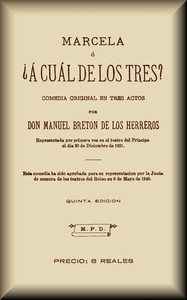
Marcela, o ¿a cuál de los tres? : Comedia original en tres actos

(4 User reviews)   713
Bretón de los Herreros, Manuel, 1796-1873 Bretón de los Herreros, Manuel, 1796-1873
Spanish
Hey, have you heard of this old Spanish play that's basically a Regency-era rom-com? It's called 'Marcela, or Which of the Three?' and it's a hilarious mess of a love triangle—or should I say, love square? A clever young woman named Marcela finds herself with three suitors: a passionate poet, a wealthy old man, and a serious military officer. Her guardian wants her to pick the rich one, but Marcela has other plans. It's all about witty banter, secret schemes, and a woman trying to outsmart the system to choose her own happiness. It's surprisingly fresh and funny for something written in the 1830s. If you like 'Bridgerton' but wish it had more satire and Spanish flair, give this a read.
Share

Read "Marcela, o ¿a cuál de los tres? : Comedia original en tres actos" Online

This book is available in the public domain. Start reading the digital edition below.

START READING FULL BOOK
Instant Access    Mobile Friendly

Book Preview

A short preview of the book’s content is shown below to give you an idea of its style and themes.

(_Se pasea. Don Agapito, aburrido, se pone a trabajar en su cordón_). MARCELA. ¡Que siempre ha de estar de broma este don Martín! AGAPITO. (_A don Amadeo_). Amigo, poco favorable sopla el viento para nosotros. Don Martín es quien la logra. Mire usted qué amartelado, qué ufano está... No me importa. Yo sé bien que si Marcela de algún galán se enamora, será de mí, porque al cabo y al fin, aunque no me toca alabarme... ¡Ah, qué ocurrencia! ¿Por qué no hace usté unas coplas satíricas contra ese hombre que tanto nos encocora? AMADEO. No estoy para coplas. AGAPITO. Pero... AMADEO. Ni jamás contra personas determinadas... AGAPITO. No le hace. La venganza es muy sabrosa. Pero ya se ve, no siempre las deidades de Helicona... ¿Y que tiene usté entre manos ahora? AMADEO. Nada. (¡Qué mosca es el hombre!) AGAPITO. ¿Algún soneto a los desdenes de Flora? ¿Algún agudo epigrama? ¿O bien algunas estrofas? AMADEO. ¡Hombre!... AGAPITO. ¿O quizá algún poema al céfiro y a la aurora? AMADEO. No pienso... AGAPITO. ¿Alguna elegía? ¿Alguna oda? ¡Oh!, las odas... AMADEO. No señor. Voy a escribir, no con tinta, con ponzoña, una sátira sangrienta contra hombrecillos de alcorza, que solo tienen talento para bailar la gavota; que por un yerro de imprenta son hombres y no son monas; que huelen a majaderos al través de tanto aroma; que si España fuera Egipto, pudieran pasar por momias; que con su voz de falsete los oídos me destrozan; que con su extraña figura siempre a risa me provocan; que con sus gestos me pudren, me empalagan con sus modas... y en fin, con necias preguntas, me fastidian, me sofocan. AGAPITO. Ya; pero eso ha de entenderse con quien... MARCELA. Doblemos la hoja, don Martín, y guarde usted para quien no le conozca esas frases de cartilla. MARTÍN. ¿Y por qué ha de ser lisonja, y no...? MARCELA. ¡Por Dios, don Martín! Mire usted que no soy tonta. MARTÍN. (Otra será su respuesta cuando me declare en forma.) MARCELA. Amigo don Amadeo, ¿teme usted que se le coman? ¿Cómo así, tan retirado? AMADEO. Quien de prudente blasona, señorita, se retira si conoce que incomoda. MARCELA. ¡A mí incomodarme usted! Con decirlo me sonroja. Don Martín me estaba hablando; y como siempre es chistosa su conversación... MARTÍN. (Yo venzo.) MARCELA. Me hacen gracia hasta las bolas que suele ensartar. MARTÍN. ¡Marcela! MARCELA. Yo le oigo como una boba. Ni era cosa de dejarle con la palabra en la boca. AGAPITO. ¡Sí; fácil es! MARCELA. Yo no gusto de insípidas ceremonias, y trato con confianza a mis amigos. Ahora soy de usted. AMADEO. (¡Oh dulces ojos! ¡Oh voz que el alma me roba!) Marcelita... MARCELA. ¿Piensa usted publicar alguna obra de su ingenio? MARTÍN. Mal hará, si no es alguna espantosa novela donde haya espectros, y violencias y mazmorras, y almas en pena, y suicidios... y en fin, eso que está en boga. Sobre todo, gran cartel, con cada letra tan gorda, y te haces hombre. Si aspiras a merecer la corona de escritor clásico, puro; si cuidas más de la gloria que del dinero, ¡ay de ti!, ningún cristiano te compra. AMADEO. No me desvela el afán de verme impreso. Es tan poca la confianza que tengo en mis versos... MARCELA. Es muy propia del verdadero saber la modestia. AMADEO. Usted me honra. (¡Oh bella!) MARCELA. Mas yo, que soy su amiga y admiradora, y por usted me intereso tanto... AMADEO. (¡Bien haya tu boca!) MARCELA. Siento que versos tan lindos, y que justamente elogian sujetos de ciencia y gusto, el público desconozca, cuando hace...

This is a limited preview. Download the book to read the full content.

Let's talk about a play that proves people have always loved a good romantic comedy. Written in 1831 by Manuel Bretón de los Herreros, Marcela, o ¿a cuál de los tres? is a sharp and funny look at love, money, and choice.

The Story

Marcela is a bright and charming young woman under the care of her uncle, Don Braulio. He's pushing her to marry Don Luis, a rich but much older man, to secure her future. The problem? Marcela isn't interested. Complicating matters are two other suitors vying for her attention: the overly dramatic poet, Don Juan, and the stern but honorable soldier, Don Felix. The play follows Marcela as she cleverly navigates this three-way courtship, using her wit to test their characters and delay her guardian's plans, all while figuring out what—and who—she truly wants.

Why You Should Read It

What I love most is Marcela herself. She's no passive heroine. She's actively playing the game, making fun of the poet's flowery lines and finding ways to avoid a marriage she doesn't want. Bretón de los Herreros has a fantastic ear for dialogue; the conversations are snappy and full of playful irony. While it's a comedy, it quietly questions the social rules of its time, especially the pressure on women to marry for security instead of affection. You're rooting for Marcela the whole time.

Final Verdict

This is a perfect pick for anyone who enjoys classic comedies of manners, like the works of Jane Austen or Oscar Wilde, but wants to explore a Spanish perspective. It's also great for readers curious about 19th-century literature but wary of dense, heavy texts. The plot moves quickly, the humor holds up, and Marcela's struggle for autonomy feels timeless. Grab it for a clever, entertaining escape that's more insightful than it first appears.


🟢 Free to Use

Legal analysis indicates this work is in the public domain. Use this text in your own projects freely.

Kevin Miller
1 month ago

This stood out immediately because it manages to explain difficult concepts in plain English. This book will stay with me for a long time.

Betty Scott
2 weeks ago

Surprisingly enough, the examples used throughout the text are practical and relevant. This deserves far more attention.

Lisa Thomas
5 months ago

From an academic standpoint, the storytelling feels authentic and emotionally grounded. Simply brilliant.

Liam Hernandez
1 month ago

Make no mistake, the content encourages further exploration of the subject. This sets a high standard for similar books.

4
4 out of 5 (4 User reviews )

Add a Review

Your Rating *
There are no comments for this eBook.
You must log in to post a comment.
Log in

Related eBooks