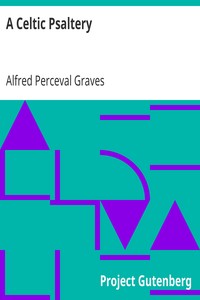
A Celtic Psaltery by Alfred Perceval Graves

(4 User reviews)   872
Graves, Alfred Perceval, 1846-1931 Graves, Alfred Perceval, 1846-1931
English
Ever wondered what ancient prayers sounded like when they weren't in Latin? That's the quiet magic of 'A Celtic Psaltery.' This isn't a novel with a villain—it's a gentle, century-old project by Alfred Perceval Graves to bring the lyrical beauty of Celtic spirituality into English. The 'conflict' here is subtle: it's the quiet struggle to capture the soul of old Irish and Welsh hymns without losing their music. If you've ever felt a chill from an old folk song or been curious about the prayers that shaped the landscapes of Ireland and Wales, this collection opens a window to a world of quiet, profound beauty. It's like finding a forgotten, well-worn path in the woods.
Share

Read "A Celtic Psaltery by Alfred Perceval Graves" Online

This book is available in the public domain. Start reading the digital edition below.

START READING FULL BOOK
Instant Access    Mobile Friendly

Book Preview

A short preview of the book’s content is shown below to give you an idea of its style and themes.

the less able to expose and scourge the immoralities of his age. The Vicar Pritchard, otherwise the Rev. Rhys Pritchard, was the author of the famous "Welshmen's Candle," "Cannwyll y Cymry," written in the free metres, first published in 1646--completed in 1672. This consisted of a series of moral verses in the metres of the old folk-songs (Penillion Telyn) and remained dear to the hearts of the Welsh people for two centuries. Next may be mentioned Goronwy Owen, educated by the poet Lewis Morris, grandfather of the author of "Songs of Two Worlds" and "The Epic of Hades." As the Rev. Elvet Lewis writes of him: "Here at once we meet the true artist lost in his art. His humour is as playful as if the hand of a stern fate had never struck him on the face. His muse can laugh and make others laugh, or it can weep and make others weep." A specimen is given of one of his best known poems, "An Ode on the Day of Judgment," reproducing, as far as my powers have permitted, its final and internal rhymes and other metrical effects. We now reach the most individual of the modern Welsh religious and philosophical poets, Islwyn (William Thomas), who took his Bardic title from the hill of Islwyn in his native Monmouthshire. He was greatly influenced by the poetry of Wordsworth, but was in no sense an imitator. Yet whilst, in the words of one of the Triads, he possessed the three things essential to poetic genius, "an eye to see nature, a heart to feel nature: and courage that dares follow nature"--he steadfastly refused to regard poetry as an art and, by declining to use the pruning-knife, allowed the finest fruits of his poetic talents to lie buried beneath immense accumulations of weedy and inferior growth. Yet what his powers were may not be ill judged of, even in translation, by the passage from his blank verse poem, "The Storm," entitled "Behind the Veil," to be found on p. 94. Pantycelyn (the Rev. William Williams) was a co-worker with Howel Harris and Daniel Rowlands in the Methodist revival. Professor W.J. Gruffyd writes of him: "It is not enough to say he was a hymnologist--he was much more. He is the National Poet of Wales. He had certainly the loftiest imagination of all the poets of five centuries, and his influence on the Welsh people can be gauged by the fact that a good deal of his idiom or dialect has fixed itself indelibly in modern literary Welsh." The Hymn, "Marchog Jesu!" which represents him was translated by me at the request of the Committee responsible for the Institution Ceremony of the Prince of Wales at Carnarvon Castle. Of the more modern Welsh poets represented in this volume let it be said that Ceiriog (John Hughes), so called from his birth in the Ceiriog Valley, is the Burns of Welsh Poetry. Against the spirit of gloom that the Welsh Revival cast over the first half of the nineteenth century he threw himself in sharp revolt. But while the joy of life wells up and overflows in his song he was also, like all Welshmen, serious-minded, as the specimens given in my translation from his works go to prove. According to Professor Lewis Jones, no poem in the strict metre is more read than Eben Farrd's "Dinistur Jerusalem" ("The Destruction of Jerusalem"), translated into kindred verse in this volume, unless indeed its popularity is rivalled by Hiraethog's ode on "Heddwch," ("Peace"). Two extracts from the former poem are dealt with, and Hiraethog is...

This is a limited preview. Download the book to read the full content.

Alfred Perceval Graves, a respected figure in the Irish literary revival, spent years translating and adapting ancient Celtic hymns, prayers, and spiritual poems. 'A Celtic Psaltery' is the result—a curated collection that tries to carry the feeling of these works from their original languages into English verse.

The Story

There's no traditional plot. Instead, think of it as a guided tour through the spiritual heart of Celtic tradition. Graves acts as your guide, presenting poems that praise nature, seek protection, and explore faith with a distinctive, earthy reverence. You'll find invocations to saints, laments, and songs of praise that feel deeply connected to the land and sea.

Why You Should Read It

This book is a quiet surprise. The language is simple but powerful, and it completely avoids the flowery, overly formal tone you might expect. Reading it feels less like study and more like listening. You get a real sense of a spirituality that saw the divine in everyday life—in blackbirds, shorelines, and hearth fires. It's a peaceful, grounding read that offers a beautiful alternative perspective on faith and poetry.

Final Verdict

Perfect for readers who love poetry, have an interest in Celtic culture, or are simply looking for a contemplative, different kind of book. It's not a page-turner; it's a book to sip slowly, maybe one poem with your morning tea. If you enjoy the works of early Yeats or the feeling of ancient folklore, Graves's psaltery will feel like a discovered treasure.


🔓 Free to Use

This historical work is free of copyright protections. You can copy, modify, and distribute it freely.

Donna Moore
1 month ago

This download was worth it since the progression of ideas feels natural and coherent. This left a lasting impression on me.

Thomas Rivera
2 months ago

Given the topic, the pacing is just right, keeping you engaged from start to finish. This felt rewarding to read.

Robert Brown
2 months ago

From an academic standpoint, it challenges the reader's perspective in the most intellectual way. This was both informative and enjoyable.

Sandra Hill
3 months ago

I went into this with no expectations and it creates a vivid world that you simply do not want to leave. It exceeded all my expectations.

4
4 out of 5 (4 User reviews )

Add a Review

Your Rating *
There are no comments for this eBook.
You must log in to post a comment.
Log in

Related eBooks