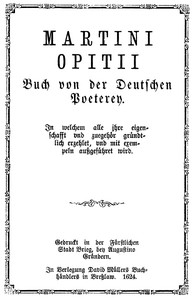
Buch von der Deutschen Poeterey by Martin Opitz

(5 User reviews)   1052
Opitz, Martin, 1597-1639 Opitz, Martin, 1597-1639
German
Ever wonder why German poetry sounds the way it does? This is the book that started it all. Martin Opitz's 'Buch von der Deutschen Poeterey' isn't a storybook—it's a rulebook. Written in 1624, it's the manifesto that convinced a whole culture to take its own language seriously for art. Imagine someone telling poets, 'Stop copying the French and Italians; our language can be beautiful too.' He laid down the law on rhyme and meter, basically creating the playbook for German literature for the next two centuries. It's short, surprisingly direct, and reading it feels like finding the original blueprint for a house you've lived in your whole life. If you've ever enjoyed a poem by Goethe or Heine, you owe a little thanks to this guy.
Share

Read "Buch von der Deutschen Poeterey by Martin Opitz" Online

This book is available in the public domain. Start reading the digital edition below.

START READING FULL BOOK
Instant Access    Mobile Friendly

Book Preview

A short preview of the book’s content is shown below to give you an idea of its style and themes.

In Fraktur gedruckte Passagen in Antiqua-Text wurden mit = markiert. In Antiqua gedruckte Passagen in Fraktur-Text wurden mit _ markiert. Hochgestellte Zeichen wurden mit vorangestelltem ^ wiedergegeben. m und n mit Makron wurden als ṁ bzw. ṅ wiedergegeben. ] Buch von der deutschen Poeterei von Martin Opitz Abdruck der ersten Ausgabe (1624) Vierter Druck Halle a. S. Verlag von Max Niemeyer 1913 Neudrucke deutscher Litteraturwerke des XVI. u. XVII. Jahrhunderts. No. 1. Einleitung. Seit dem Erscheinen dieser Ausgabe (1876. 1882) ist das Buch von der deutschen Poeterei Gegenstand eindringender Forschung geworden, durch welche seine Stellung in der Geschichte der Poetik, sowie die Beziehungen zu den Quellen Opitzens hinlänglich klargestellt worden sind. Abgeschlossen wurden diese Untersuchungen durch die mit Einleitung und eingehendem Commentar versehene Ausgabe: 'Martin Opitzens Aristarchus sive de contemptu linguae Teutonicae und Buch von der Deutschen Poeterey, herausgegeben von Dr. Georg ~Witkowski~.' Leipzig 1888. Die wichtigeren Einzelabhandlungen sind: O. Fritsch, Martin Opitzens Buch von der d. P. Ein kritischer Versuch (Diss.), Halle 1884; -- K. Borinski, Die Kunstlehre der Renaissance in Opitz' Buch von der d. P. (Diss.), München 1883, und danach in desselben 'Die Poetik der Renaissance und die Anfänge der litterarischen Kritik in Deutschland', Berlin 1886, S. 63 ff.; -- W. Berghoeffer, Martin Opitz Buch von der d. P. (Göttinger Diss.), Frankfurt a/M. 1888; [-- R. Beckherrn, M. Opitz, P. Ronsard und D. Heinsius (Diss.) Königsberg 1888; -- G. Wenderoth, Die poetischen Theorien der französischen Plejade in Martin Opitz' deutscher Poeterei: Euphorion 13, 445-468.] * * * * * Das Buch von der deutschen Poeterei erschien in Breslau 1624. Die Ausgabe ist in 4^o und besteht aus 38 ungezählten Blättern (= 9½ Bogen) mit den Signaturen =A=-=K=, angehängt sind dann noch zwei Blätter »=An den Leser=« mit Signatur =L=. Diese Ausgabe ($A$) liegt unserem Abdrucke zu Grunde. Derselbe ist für diesen Druck, unter Berücksichtigung der Ausgabe von Witkowski, von neuem mit dem Originale (Ex. der Stadtbibliothek in Leipzig) sorgfältig verglichen worden. Abgewichen ist von der Originalausgabe nur insofern, als ihre Druckfehler verbessert sind. Diese zerfallen in 3 Klassen: 1) Druckfehler, die von Opitz selbst in dem Anhange »=An den Leser=« (S. 59) als solche aufgeführt werden. Es folgt hier das Verzeichniss derselben nach Seite und Zeile unseres Abdrucks: 7 7 inimicæ vene. 9 27 Ην' ποτέ σοι χρὁνος οῦτος έν. 10 7 =heutiges tagen=. 11 33 ἰδιόρητα. 12 11 =Marcilius=. 15 2 μὲν̀. 15 30 d, escorte. 19 1 =habe=] =hate=. 23 21 =kürtze=] =kurtze=. 27 37 τωὴ, ὴ ψυχὴ. 29 6 =nechst=] =echst=. 29 11 L irrite. 32 7 ciel] liel. 32 21 =auff einandere=. 32 31 =abstehlen=] =abstehen=; -- =möge=] =mögen=. 37 20 =stehen=] =sehen=. 38 24 θάλααστα. 38 25 θάλ ασταν. 38 29 distichion. 38 30 =Ancareonten=. 41 8 =nach=] =noch=. 41 20 =lateinischen ~vnd~= hexametros. 41 37 communs =~der~ gemeinen=. 43 39 =abschnitt=] =abschrit=. 44 35 =himmelront=. 44 40 =Iu summa=. 53 23 STRO. I. 56 4 ἐνκρίνεσθαι. -- Ausserdem gibt Opitz noch zu 15 29 =genawe= an, welches aber schon im Texte ebenso richtig dasteht. 2) Ferner sind folgende gröbere Druckfehler verbessert, die zum Teil in allen, zum Teil auch nur in einzelnen der älteren Ausgaben beseitigt sind: 26 34 =satt=] =saat= (doch vgl. Anz. f. dtsch. alt. 14, 287). 27 17 =reime=] =reine=. 28 29 =denn=] =den=. 29 38 =Haupt-brecher-Löwen-zwinger=. 33 2 =erempel=. 36 28 =ö=] ὂ. 40 2 =doppeltlaudender=. 40 10 =der andere=] =~das~ a.= 42 12 =abschritt= (43 39 derselbe Fehler von Opitz verbessert). 46 14 C'ouurir. 48 19 =nicht=] =nchit=. 48 23 =vneigeflochtenen=. 49 22 =Capittl=. 51 44 =Meisterück=. 56 29 =des Frawenz=. 57 30 statt =besitzen= das...

This is a limited preview. Download the book to read the full content.

The Story

There isn't a plot in the usual sense. Think of it less as a novel and more as a passionate instruction manual. Germany in the 1600s was a patchwork of states, and its literature was seen as clumsy compared to the polished works from France and Italy. Opitz had a mission: to prove German was just as capable of elegance. In this short book, he lays out clear, practical rules. He argues for using natural word stress to create rhythm instead of forcing in Latin-style meters. He champions clarity and order, showing writers how to structure their poems for maximum impact. The 'story' is the argument itself—the building of a new foundation, brick by logical brick.

Why You Should Read It

It's a fascinating look at how art gets made. Reading Opitz is like listening in on a master craftsman explaining the fundamentals of his trade. His tone isn't dry; you can feel his urgency and pride. He's not just making rules for the sake of it; he's building a toolkit so German writers can finally compete. It makes you see the poetry that came after—all the greats from the Baroque period to the Romantics—in a new light. You start to hear the underlying structure he championed. It's a powerful reminder that sometimes, creativity needs a few good rules to really take off.

Final Verdict

Perfect for curious readers who love language, history, or seeing how ideas shape culture. It's not a beach read, but it's a surprisingly brisk and impactful one. If you enjoy seeing 'how the sausage is made' in literature, or if you have any interest in German history, this is essential reading. It's the quiet, foundational text that changed a continent's literary voice.


✅ Copyright Status

This book is widely considered to be in the public domain. Feel free to use it for personal or commercial purposes.

Noah Thompson
4 weeks ago

I wasn’t planning to read this, yet the clarity of the writing makes this accessible to a wide audience. I have no regrets downloading this.

Michael Green
5 months ago

I’ve been searching for content like this and the tone remains consistent and professional throughout. Don't hesitate to download this.

Noah Green
4 months ago

Make no mistake, the depth of coverage exceeded my expectations. An unexpectedly enjoyable experienc.e

Robert Williams
5 months ago

I was skeptical at first, but the presentation feels refined and carefully planned. This sets a high standard for similar books.

Michael Carter
5 months ago

As a long-time reader of this genre, the narrative structure is incredibly compelling and well-thought-out. It exceeded all my expectations.

4.5
4.5 out of 5 (5 User reviews )

Add a Review

Your Rating *
There are no comments for this eBook.
You must log in to post a comment.
Log in

Related eBooks