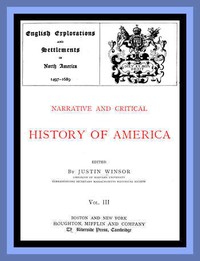
Narrative and Critical History of America, Vol. 3 (of 8) by Justin Winsor

(5 User reviews)   1019
English
Ever wonder what gets lost when we tell the story of a country? This isn't your typical history book. It’s a behind-the-scenes look at how America’s early story was actually written. Forget just dates and battles—this book shows you the arguments, the forgotten voices, and the messy process of creating a national history. It’s like finding the director’s commentary for the founding of a nation, full of debates and details your high school textbook definitely left out. If you think history is just a settled fact, this volume will make you question everything.
Share

Read "Narrative and Critical History of America, Vol. 3 (of 8) by Justin Winsor" Online

This book is available in the public domain. Start reading the digital edition below.

START READING FULL BOOK
Instant Access    Mobile Friendly

Book Preview

A short preview of the book’s content is shown below to give you an idea of its style and themes.

George Percy, 134; George Calvert, 146; William Berkeley, 147. CRITICAL ESSAY 153 AUTOGRAPHS: William Strachey, 156; Delaware, 156; John Harvey, 156; John West, 164. NOTES ON THE MAPS OF VIRGINIA, ETC. _The Editor_ 167 ILLUSTRATION: Smith’s map of Virginia or the Chesapeake, _phototype_, 167. CHAPTER VI. NORUMBEGA AND ITS ENGLISH EXPLORERS. _Benjamin F. De Costa_ 169 ILLUSTRATION: Map of Ancient Pemaquid, 177. AUTOGRAPHS: J. Popham, 175; Ferd. Gorges, 175. CRITICAL ESSAY 184 ILLUSTRATIONS: Modern map of Coast of Maine, 190; Henri II. map (1543), 195; Hood’s map (1592), 197; Smith’s map of New England (1616), 198. AUTOGRAPHS: J. Popham, 175; Ferd. Gorges, 175. EARLIEST ENGLISH PUBLICATIONS ON AMERICA, AND OTHER NOTES. _The Editor_ 199 ILLUSTRATIONS: Title of Eden’s Münster, 200; Münster’s map (1532), 201, (1540), 201; Title of Stultifera Nauis (1570), 202; Gilbert’s map (1576), 203; Linschoten, 206; John G. Kohl, 209; Lenox globe (1510-1512), 212; Extract from Molineaux globe (1592), 213; Frankfort globe (1515), 215; Molineaux map (1600), 216. AUTOGRAPHS: Humphrey Gilbert, 203; Richard Hakluyt, 204; Jul. Cæsar, 205; Ro. Cecyll, 206; John Smith, 211. CHAPTER VII. THE RELIGIOUS ELEMENT IN THE SETTLEMENT OF NEW ENGLAND.—PURITANS AND SEPARATISTS IN ENGLAND. _George E. Ellis_ 219 CRITICAL ESSAY 244 CHAPTER VIII. THE PILGRIM CHURCH AND PLYMOUTH COLONY. _Franklin B. Dexter_ 257 ILLUSTRATIONS: Site of Scrooby Manor-House, 258; Map of Scrooby and Austerfield, 259; Austerfield church, 260; Record of William Bradford’s baptism, 260; Robinson’s House in Leyden, 262; Plan of Leyden, 263; Map of Cape Cod Harbor, 270; Map of Plymouth Harbor, 272; Historic Swords, 274; Governor Edward Winslow, 277; Pilgrim relics, 279; Governor Josiah Winslow, 282. AUTOGRAPHS: John Smyth, 257; John Robinson, 259; Robert Browne, 261; Francis Johnson, 261; Signatures of Mayflower Pilgrims (William Bradford, Myles Standish, William Brewster, John Alden, John Howland, Edward Winslow, George Soule, Francis Eaton, Isaac Allerton, Samuel Fuller, Peregrine White, Resolved White, John Cooke), 268; Dorothy May, 268; William Bradford, 268; Thomas Cushman, 271; Alexander Standish, 273; James Cole, senior, 273; Signers of the Patent, 1621 (Hamilton, Lenox, Warwick, Sheffield, Ferdinando Gorges), 275; Governors of Plymouth Colony (William Bradford, Edward Winslow, Thomas Prence, Thomas Hinckley, Josiah Winslow), 278. CRITICAL ESSAY 283 ILLUSTRATIONS: Extract from Bradford’s History, 289; First page, Plymouth Records, 292. AUTOGRAPH: Nathaniel Morton, 291. CHAPTER IX. NEW ENGLAND. _Charles Deane_ 295 ILLUSTRATIONS: Dudley’s map of New England (1646), 303; Alexander’s map (1624), 306; John Wilson, 313; Dr. John Clark, 315; John Endicott, 317; Hingham meeting-house, 319; Joseph Dudley, 320; John Winthrop of Connecticut, 331; John Davenport, 332; Map of Connecticut River (1666), 333. AUTOGRAPHS: William Blaxton, 311; Samuel Maverick, 311; Thomas Walford, 311; Mathew Cradock, 312; John Wilson, 313; Quaker autographs, 314; John Endicott, 317; Colonial ministers of 1690 (Charles Morton, James Allen, Michael Wigglesworth, Joshua Moody, Samuel Willard, Cotton Mather, Nehemiah Walter), 319; Joseph Dudley, 320; Abraham Shurt, 321; Thomas Danforth, 326; Thomas Hooker, 330; John Haynes, 331; John Winthrop, the younger, 331; John Allyn, 335; William Coddington, 336; Samuel Gorton, 336; Narragansett proprietors (Simon Bradstreet, Daniel Denison, Thomas Willett, Jno. Paine, Edward Hutchinson, Amos Richison, John Alcocke, George Denison, William Hudson), 338; Roger Williams, 339. CRITICAL ESSAY 340 ILLUSTRATIONS: Seal of the Council for New England, 342; Cotton Mather, 345; Ship of the seventeenth century, 347; Fac-simile of a page of Thomas Lechford’s _Plaine Dealing_, 352; James Savage’s manuscript note on Lechford, 353; Beginning of Thomas Shepard’s Autobiography, 355. AUTOGRAPHS: Leaders in Pequot war (John Mason, Israel Stoughton, Lion Gardiner), 348; Jonathan Brewster, 349; Nathaniel Ward, 350; Signatures connected with the Indian Bible (Robert Boyle, Peter Bulkley, William Stoughton, Joseph Dudley, Thomas Hinckley, John Cotton, John Eliot, James Printer), 356; Edward Johnson,...

This is a limited preview. Download the book to read the full content.

This book is part of a massive, eight-volume project from the late 1800s that aimed to tell the whole story of America. Volume 3 focuses on the English and French colonies during the 17th and early 18th centuries. But here’s the twist: it's not just a straight narrative. The book is split. The first half gives you the historical story of settlements, conflicts, and colonial life. The second half, the "Critical" part, is where it gets fascinating. That section is a collection of essays and notes from different experts of the time, picking apart the sources, debating interpretations, and showing all the disagreements historians had (and still have).

Why You Should Read It

I loved this because it pulls back the curtain. Reading it feels like you're in a room with a bunch of 19th-century scholars arguing over maps, diaries, and old letters. You see history being built, brick by contested brick. It reminds you that the clean story we often get is the result of a lot of messy, human debate. The book itself becomes a historical artifact, showing what people a century after the Civil War thought was important about America's beginnings.

Final Verdict

This is for the curious reader who already knows the basics and wants to go deeper. It’s perfect for history buffs who enjoy seeing how the sausage is made, or for anyone who likes primary sources and scholarly debate. It’s not a light, breezy read—it demands some attention—but the reward is a much richer, more complicated understanding of how we decide what 'history' even is.


📜 Free to Use

Legal analysis indicates this work is in the public domain. You are welcome to share this with anyone.

George Brown
5 months ago

If you enjoy this genre, the material feels polished and professionally edited. It was exactly what I needed right now.

Susan Gonzalez
3 months ago

I picked this up late one night and the insights offered are both practical and thought-provoking. This turned out to be a great decision.

Melissa Torres
4 months ago

Once I began reading, the emotional weight of the story is balanced perfectly with moments of levity. Worth every second of your time.

Susan Torres
2 months ago

I have to admit, the structure allows easy navigation and quick referencing. Well wrth recommending.

Jackson Brown
3 months ago

I have to admit, the interplay between the protagonists drives the story forward beautifully. This left a lasting impression on me.
4
4 out of 5 (5 User reviews )

Add a Review

Your Rating *
There are no comments for this eBook.
You must log in to post a comment.
Log in

Related eBooks