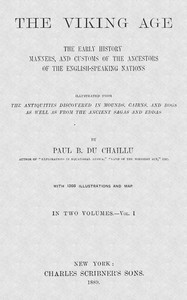
The Viking Age. Volume 1 (of 2) by Paul B. Du Chaillu

(5 User reviews)   1164
Du Chaillu, Paul B. (Paul Belloni), 1835-1903 Du Chaillu, Paul B. (Paul Belloni), 1835-1903
English
Hey, I just finished this old-school book about Vikings, and it's not what you'd expect. Forget the horned helmets—this is a real 19th-century adventure. The author, Paul Du Chaillu, was a famous explorer, and he wrote this right after his trips to Scandinavia. The 'conflict' here is fascinating: it's Du Chaillu himself wrestling with the raw, often brutal history he's uncovering, trying to make sense of it for his Victorian audience. He's piecing together sagas, archaeology, and his own observations to answer a big question: who were these people, really? It's like reading a detective story written by an Indiana Jones of his day. The mystery isn't just in the past; it's in how we choose to understand it.
Share

Read "The Viking Age. Volume 1 (of 2) by Paul B. Du Chaillu" Online

This book is available in the public domain. Start reading the digital edition below.

START READING FULL BOOK
Instant Access    Mobile Friendly

Book Preview

A short preview of the book’s content is shown below to give you an idea of its style and themes.

the love of conquest being the most prominent traits of their character. The mighty sword with all its evils has thus far always proved a great engine of civilisation. To get a satisfactory answer to the above questions we must go far back, and study the history of the race who settled in Britain during and after the Roman occupation. We shall thus find why their descendants are to-day so brave, successful, energetic and prosperous in the lands which they have colonised; and why they are so pre-eminently skilled in the art of self-government. We find that a long stretch of coast is not sufficient, though necessary, to make the population of a country a seafaring nation. When the Romans invaded Britain, the Brits had no fleet to oppose them. We do not until a later period meet with that love of the sea which is so characteristically English:—not before the gradual absorption of the earlier inhabitants by a blue-eyed and yellow-haired seafaring people who succeeded in planting themselves and their language in the country. To the numerous warlike and ocean-loving tribes of the North, the ancestors of the English-speaking people, we must look for the transformation that took place in Britain. In their descendants we recognise to this day many of the very same traits of character which these old Northmen possessed, as will be seen on the perusal of this work. Britain, after a continuous immigration which lasted several hundred years, became the most powerful colony of the Northern tribes, several of the chiefs of the latter claiming to own a great part of England in the seventh and eighth centuries. At last the time came when the land of the emigrants waxed more powerful, more populous than the mother-country, and asserted her independence; and to-day the people of England, as they look over the broad Atlantic, may discern a similar process which is taking place in the New World. The impartial mind which rises above the prejudice of nationality must acknowledge that no country will leave a more glorious impress upon the history of the world than England. Her work cannot be undone; should she to-day sink beneath the seas which bathe her shores, her record will for ever stand brilliantly illuminated on the page of history. The great states which she has founded, which have inherited her tongue, and which are destined to play a most important part in the future of civilisation, will be witnesses of the mighty work she has accomplished. They will look back with pride to the progenitors of their race who lived in the glorious and never-to-be-forgotten countries of the North, the birthplace of a new epoch in the history of mankind. As ages roll on, England, the mother of nations, cannot escape the fate that awaits all; for on the scroll of time this everlasting truth is written—birth, growth, maturity, decay;—and how difficult for us to realise the fact when in the fulness of power, strength, and pride! Where is or where has been the nation that can or could exclaim, “This saying does not apply to me; I was born great from the beginning; I am so now, and will continue to be powerful to the end of time.” The ruined and deserted cities; the scanty records of history, which tell us of dead civilisations, the fragmentary traditions of religious beliefs, the wrecks of empires, and the forgotten graves, are the pathetic and silent witnesses of the great past, and a sad suggestion of the inevitable fate in store for all. The materials used in these volumes, in describing...

This is a limited preview. Download the book to read the full content.

This isn't a modern, neatly-packaged history. The Viking Age, Volume 1 is a journey led by a 19th-century explorer. Paul Du Chaillu takes the sagas and historical fragments he collected and tries to build a picture of Norse life before the famous raids began. He covers their gods, their home life, their ships, and their social structure, setting the stage for the explosive events to come in Volume 2.

Why You Should Read It

You get two books in one. First, you learn about the Vikings. Second, and just as compelling, you get a front-row seat to how history was written 150 years ago. Du Chaillu's voice is present on every page—sometimes amazed, sometimes judgmental, always passionate. Reading his interpretations, knowing what we know now, adds a whole extra layer of interest. It’s history, but it feels alive with the author's own curiosity and biases.

Final Verdict

Perfect for readers who love primary sources and a sense of discovery. If you enjoy history but find some academic texts dry, Du Chaillu's adventurous spirit might pull you right in. Be prepared for some outdated ideas—that's part of the book's charm as a historical artifact itself. It's a foundational, if dusty, cornerstone for anyone curious about how our view of the Vikings was first shaped.


🏛️ Usage Rights

This digital edition is based on a public domain text. It serves as a testament to our shared literary heritage.

Thomas Davis
4 months ago

From a technical perspective, the formatting of this PDF is flawless and easy to read on any device. This felt rewarding to read.

Donald Wilson
5 months ago

Without a doubt, the explanations are structured in a clear and logical manner. This was both informative and enjoyable.

Steven Taylor
2 months ago

Initially overlooked, this book the diagrams and footnotes included in this version are very helpful. A solid resource I will return to often.

Mason Clark
2 months ago

I decided to give this a chance and the character development is subtle yet leaves a lasting impact. This book will stay with me for a long time.

Melissa Moore
3 months ago

Once I started reading, the content flows smoothly from one chapter to the next. It is definitely a 5-star readd from me.
5
5 out of 5 (5 User reviews )

Add a Review

Your Rating *
There are no comments for this eBook.
You must log in to post a comment.
Log in

Related eBooks